Why Every SEO Team Needs a Prioritization Tool to Focus Efforts
@seoprioritizationtoolworks
October 26, 2026 · 7 min read
Anyone who has managed SEO for more than a few months knows the feeling. You open a project management board, and there are forty tasks staring back at you. Fix broken redirects, update old blog posts, add structured data to product pages, improve page speed on the highest-traffic URLs, and maybe finally get around to that content gap analysis you have been meaning to run. The problem is rarely a lack of things to do. It is knowing which thing to do first.
That is where a proper seo prioritization tool becomes worth its weight in coffee and late nights. Not another dashboard that floods you with metrics, but something that helps you decide what actually moves the needle for the queries that matter to your business. Most SEOs I know have tried the spreadsheet approach. You list tasks, assign a score for effort and impact, and then sort by some homemade formula. It works for a while, but it breaks down when you have data coming from Google Search Console, Ahrefs, SEMrush, and Moz all at once. You end up with a mess of export files and conflicting signals.
What Makes Prioritization Hard in SEO
The core challenge is that SEO is a multi-variable system. A single ranking factor rarely works in isolation. You might see that a page has good keyword difficulty and decent search volume, but its click-through rate is low because the title tag is weak and the structured data is missing. Another page might have a strong backlink profile but load slowly on mobile, and Core Web Vitals are dragging it down. Without a systematic way to weigh these factors together, you end up making decisions based on whichever report you looked at last.
I have seen teams spend weeks optimizing a page that already ranked in position three, while a page on position eleven with higher commercial intent sat untouched. That is not a people problem. That is a prioritization problem. The data was there. Google Analytics showed the traffic difference. Google Search Console showed the impression numbers. But no single view tied it together in a way that made the right action obvious.
How a Structured Tool Changes the Conversation
A good seo prioritization tool does not replace your judgment. It organizes the evidence so your judgment has a clearer signal to work with. Instead of arguing about whether to fix canonical tag issues or rewrite a product category page, you can see the relative lift each action is likely to produce for a given set of keywords. That shifts the conversation from opinion to hypothesis, which is a much better place to work from.
For example, you might have a set of pages where the content is thin and the backlink profile is weak. A content gap analysis using a tool like Ahrefs or SEMrush might show that competitors are covering subtopics you have ignored. But if those same pages also have robots.txt blocks that prevent indexing, fixing the access issue will come first. A prioritization tool that factors in technical blockers, content relevance, and competitive pressure helps you see that order clearly.
Kinds of Signals a Prioritization Tool Should Weigh
Not all signals matter equally for every site, but a few categories tend to show up again and again. The best tools let you weight these according to your own context.
- Technical health: issues like missing canonical tags, broken XML sitemaps, slow page speed, and failing Core Web Vitals. These are often the highest leverage because they affect everything else.
- Content relevance: TF-IDF and Latent Semantic Indexing signals that tell you whether your page covers the topic comprehensively. If your content is thin, no amount of technical polish will rank it for competitive terms.
- Competitive pressure: keyword difficulty, search volume trends, and the backlink profile of pages currently ranking. If the top ten results all have strong domain authority, you need a different strategy than if the SERP is full of weaker pages.
- User behavior: click-through rate from search results, bounce rate from Google Analytics, and engagement metrics that indicate whether searchers find what they need.
When you combine these signals into a single view, the highest priority tasks start to surface naturally. You might find that a page with great content and good backlinks is underperforming simply because it has no structured data. Adding that markup could take hours, not weeks, and the potential uplift in visibility is immediate.
The Problem with Manual Prioritization
I have worked with teams that rely entirely on manual triage. They run a Screaming Frog crawl, export the list of broken links and missing titles, and then fix them in the order the spreadsheet lists them. That approach misses context. A broken link on a page that gets no traffic is less important than a missing canonical tag on your highest-traffic product page. But a flat export does not tell you that.
Similarly, looking at keyword difficulty in isolation can be misleading. A keyword might show high difficulty, but if your page already has a strong backlink profile and solid content, the actual effort to rank might be lower than a keyword with medium difficulty where you have no authority at all. A prioritization tool that models these trade-offs helps you avoid wasting time on low-probability bets.
Bringing in RankGear for the Optimization Layer
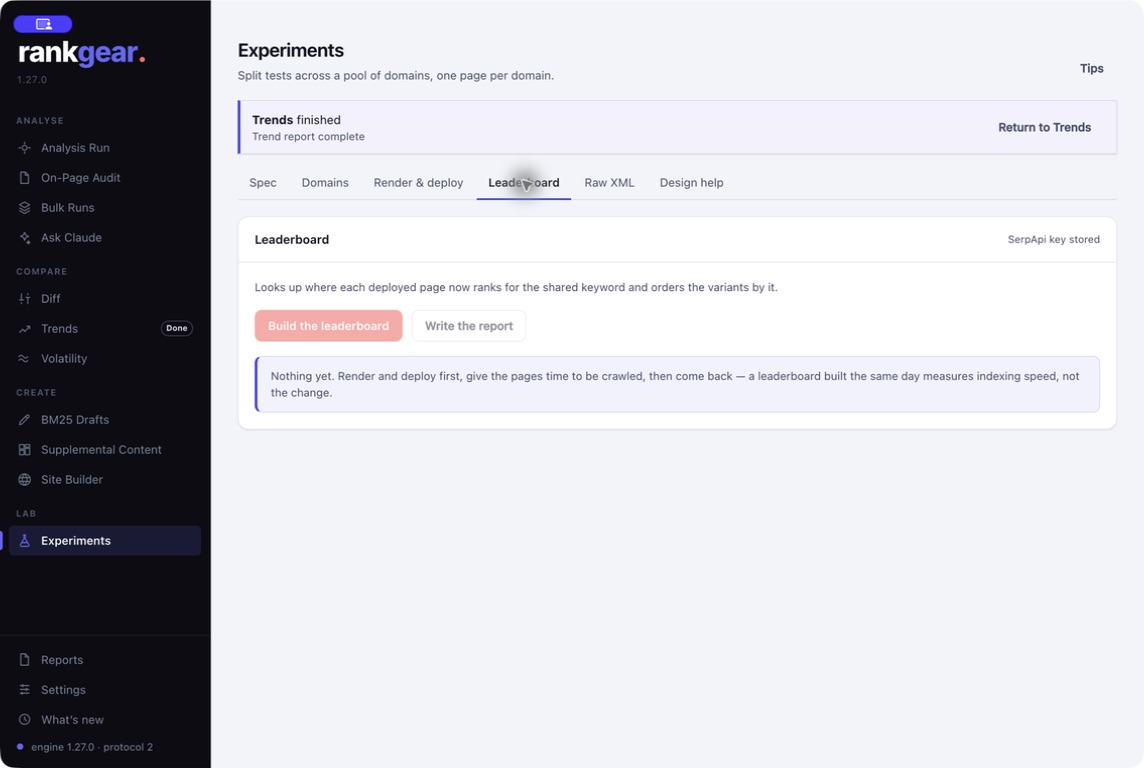
This is where a platform like RankGear fits into the workflow. RankGear is SEO software that analyzes ranking factors for specific queries and provides actionable, evidence-based optimization plans. Instead of just showing you a list of metrics, it ties those metrics to specific recommendations. If a page is underperforming because its TF-IDF relevance is weak against the top competitors, the plan tells you what to add. If the Core Web Vitals scores are failing, it points to the specific elements causing the problem.
The value is not in the data itself. You can get ranking factor data from a dozen sources. The value is in the synthesis. A tool that turns raw signals into a ranked list of actions saves you from having to mentally cross-reference Google Search Console with Ahrefs and Moz every time you plan a sprint. It gives you back the time you used to spend on data janitor work, so you can spend it on strategy and execution.
Practical Ways to Use a Prioritization Tool in Your Workflow
I have found that the most effective way to use a seo prioritization tool is to run it at the start of each sprint or monthly cycle. Export the top twenty opportunities it identifies, review them with your team, and pick the five that align with your current business goals. The tool provides the data, but the team provides the context. Maybe a low-priority technical fix is actually critical because a client is complaining about that page. Maybe a content update looks high-impact but your writers are already booked for the week. The tool does not replace those decisions. It just makes sure you are not overlooking something obvious.
Another approach is to use it for quarterly audits. Run the tool across your entire site or a major section, and look for patterns. You might discover that a whole category of pages shares a common weakness, like missing XML sitemaps or poor internal linking. Fixing that pattern across dozens of pages at once can produce a compounding effect that individual fixes rarely achieve.
What to Look For in a Tool
Not every prioritization tool is worth the subscription. The ones that work well share a few traits. They let you input your own data sources, whether that is Google Search Console, Google Analytics, or third-party crawlers. They model the relationship between different factors rather than just averaging scores. And they present the output in a way that makes the next action obvious, not just a number to interpret.

If a tool gives you a score of 73 for one page and 68 for another, but does not tell you why the first page scored higher, it is not helping you prioritize. It is just adding more noise. Look for tools that explain the reasoning behind the ranking, so you can verify the logic and learn from it over time.
Final Thoughts
SEO is full of competing priorities. Every week brings new data, new algorithm updates, and new opportunities. The teams that stay ahead are not necessarily the ones with the most resources. They are the ones that make better decisions about where to put their resources. A solid seo prioritization tool does not guarantee you will make the right call every time, but it dramatically improves your odds. And over a quarter or a year, that edge compounds into real traffic and revenue gains.